
BOSCH Adventures · Field Notes
Fourteen days alone on the road between the Zambezi, Bazaruto and Ilha de Moçambique—a story about patience, encounters and arriving at the sea.
Chapter 1 · Setting off: a country you cannot understand in passing
Mozambique had been on my list for a long time—not as a quick extension to another trip, but as a chapter of its own: long, contradictory and open-ended enough that I could not know in advance how each day would end.
Fourteen days later, I had travelled around 5,800 kilometres. I had driven through rain and dust, ridden in truck beds, waited in villages and met people whose names I could not always remember, but whose generosity stayed with me. The plan mattered—especially because it changed so often along the way.
Chapter 2 · Tete: when the next leg takes shape after dark
After almost a full day getting to the border, I continued toward Tete on the Zambezi. I was hitchhiking, travelling with truckers and whatever else happened to be moving. From the beginning it was clear that in Mozambique you measure distance not only in kilometres, but also in patience.
A truck driver first offered to take me almost 300 kilometres. Then came stops for passengers, chickens and charcoal. About 110 kilometres before Tete, his plans changed: he wanted to go out and celebrate. So I waited in a small village in the dark until a late pickup truck carried the story forward.
It was not the kind of moment you would put in a travel brochure. But it was the truth of the journey: I did not have to control everything to keep moving. Sometimes it was enough to stay open and trust that another possibility would appear.
Chapter 3 · Vilanculos: after 1,800 kilometres, the sea feels like a gift
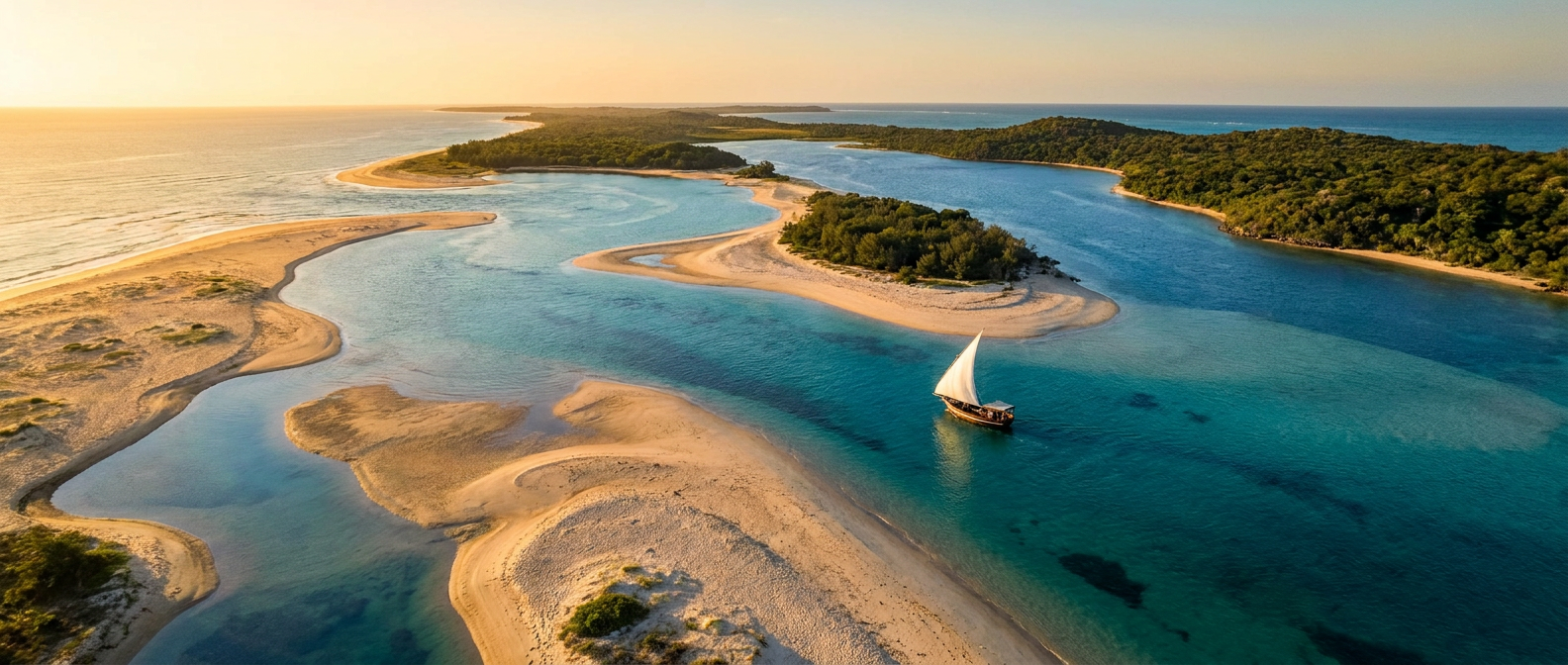
Three days and around 1,800 kilometres later, Vilanculos came into view. The Bazaruto Archipelago, turquoise water and pale sand reflecting the light: after truck beds, rain, breakdowns and police checkpoints, the sea was more than beautiful. It was a turning point.
I stayed for five days—not because there was nothing left to discover, but because for the first time I did not have to move on immediately. The water was calm in the morning; later, boats crossed the lagoon. By evening, a foreign coastline had become a place where I knew where to get my coffee.
Pauses like these are not wasted time on a long journey. They give the days before them meaning. Only when you slow down do you notice how much has happened along the way.
Chapter 4 · Farther north: the road remains part of the adventure
My destination was Ilha de Moçambique. The way there meant rough roads again, crowded vehicles and stops that never appeared on a timetable. At one point, I was stranded on New Year’s Eve. The following day, at around 2 p.m., I finally arrived.
The island welcomed me with Portuguese history, weathered facades and the Indian Ocean right outside. After the long legs of the journey, the place felt almost unreal: quieter, but no less intense. Centuries of trade, colonial history and local life seemed layered on top of one another.
I realised there that the journey was not made up of individual sights. It was made up of transitions: from Tete to the sea, from waiting to arriving, from being a stranger to brief moments when someone makes room for you and you feel you belong.
Chapter 5 · What stays with you: not everything went to plan—and luckily so
Mozambique did not win me over with comfort. It won me over with its force: a long coastline, diverse cultures, great distances and people who often turned a difficult leg into a manageable next step.
When I think about the trip now, I do not first remember the kilometre count. I remember waiting in the dark, the first view of the water in Vilanculos, the sounds on the island and the feeling of arriving despite all the detours.
Perhaps this is the best way to travel through a country: do not smooth everything out. Have a plan, but leave enough room for the story that actually unfolds along the way.
Plan your journey with local insight.
Tell us where you would like to go and what matters most. We’ll help you shape a realistic route around the season, your pace and the experiences you value.
Plan your journey