
BOSCH Adventures · Field Notes
A 17-day journey through South Africa, designed for a small group and led with local knowledge.
17 days, one bus, ten friends
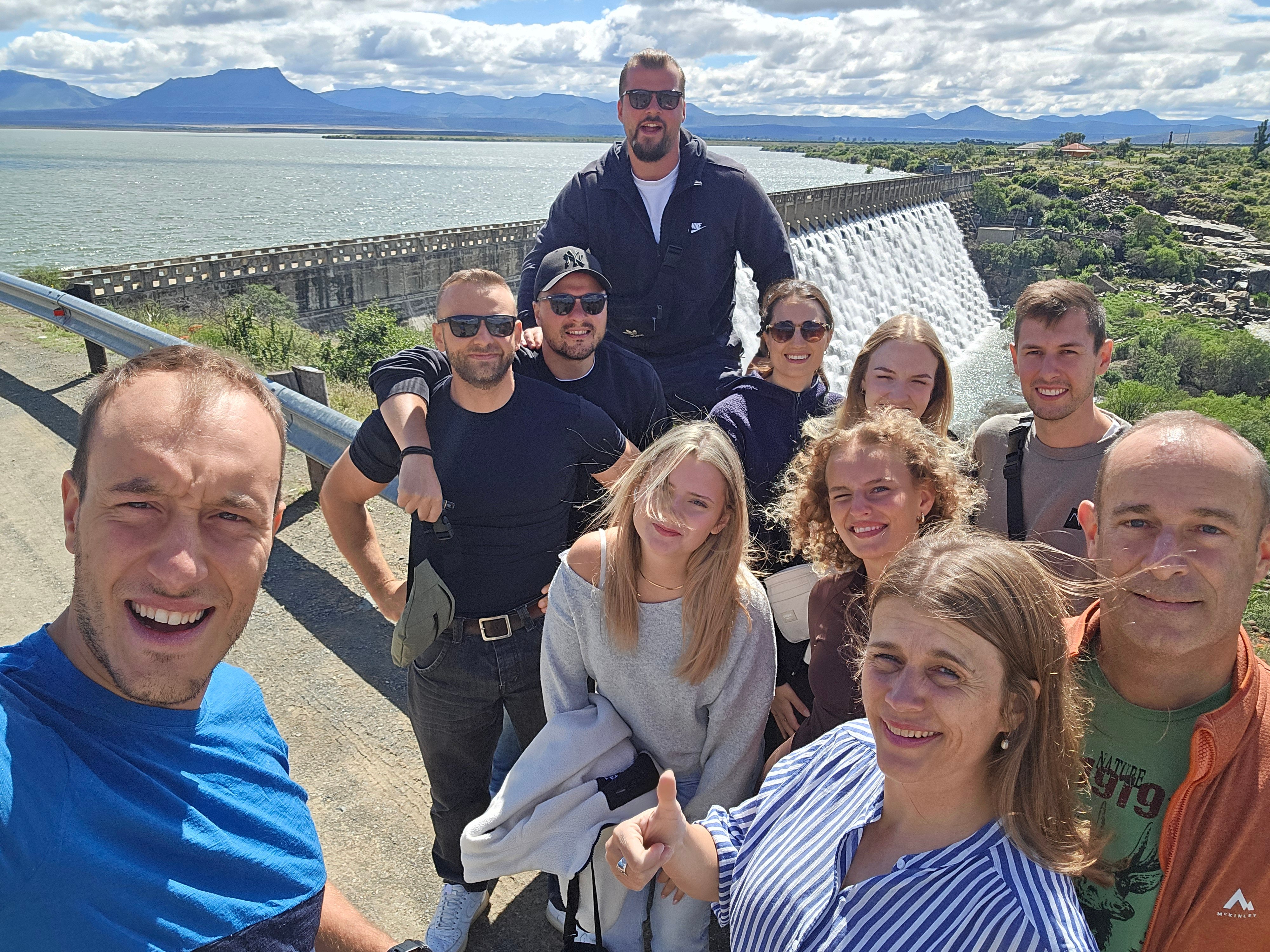
When our 11-seat Toyota Quantum travels South Africa’s roads, we are not only looking at breathtaking landscapes—we are turning the pages of a living history book with every kilometre. This report follows our small-group journey in September 2026, from Johannesburg to Cape Town.
To understand South Africa, look beneath the tourist surface. This journey took us into the contrasts of a country shaped by immense wealth, deep injustice and an irrepressible desire for freedom.
Days 1–2 · Johannesburg: where the gold rush shaped a nation
Our journey begins where South Africa’s modern history took shape. Johannesburg appeared almost from nowhere in 1886, after the world’s largest gold reef was discovered on the Witwatersrand. Within a few years, a mining camp had become a metropolis—and an economic system built on cheap labour and strict segregation had grown with it.
Today the legacy is still visible: major highways and enormous ochre mine dumps cut through the urban landscape. Much of this infrastructure was deliberately built during apartheid as a physical barrier between affluent white suburbs and Black townships. From the first day, it is clear that this trip will raise questions as well as offer beautiful views.
For the group, Johannesburg is the moment of arrival: eleven seats in the Toyota Quantum, bags on the roof and the first names to remember. Over our first shared meal, it already feels as if a crew—not ten separate travellers—is on the road.
Day 3 · Graskop and the Panorama Route: rivers of sorrow and joy
Via the charming town of Graskop, we climb onto the spectacular Panorama Route. At the edge of the densely forested Blyde River Canyon—one of the world’s largest gorges—we stand at viewpoints such as God’s Window and the Three Rondavels and look hundreds of metres down.
Echoes of the Great Trek still linger here. In the nineteenth century, Boer Voortrekkers moved into the unknown while fleeing British rule. The river names tell their story: at the Treur River, or River of Sorrow, families waited anxiously for an expedition they believed lost; at the Blyde River, or River of Joy, they were reunited.
These pioneers compared themselves in their Calvinist faith to the Israelites on their way to the Promised Land. Their idea of freedom would shape the country for centuries—and accompany us along the route.
Days 4–6 · Kruger National Park and Marloth Park
From the canyon plateau, we descend into the raw wilderness of Kruger National Park. Around Skukuza, we experience the Africa many of us imagined as children: impala herds in the morning light, vultures above a carcass, rhinos in the thornbush. Then a wise elephant matriarch and her family silently cross the road in front of our bus. No one says a word; only cameras click.
Instead of an anonymous lodge, we stay in a house in Marloth Park, right on the park boundary. There are no fences between the terrace and the bush. Giraffes nibble acacias beside the barbecue, zebras and kudus come right up to the house, and at night we hear lions calling in the distance.
On our shared night safari, we hold our breath as a spotlight catches a pride of lions beside the road. Back in Marloth Park, we sit around the fire while the braai sizzles and a giraffe peers curiously over the fence. That evening, fellow travellers become friends.
Day 7 · Genesis Route and Barberton: macadamias, citrus and land
We leave the park along the breathtaking Genesis Route toward Barberton. The road winds through endless green curves in the Makhonjwa Mountains, among the oldest rock formations on Earth. Spontaneous photo stops are part of travelling in a small group.
The bush suddenly gives way to highly intensive agriculture. The hot Lowveld is covered in dark-green macadamia trees and lush citrus plantations. At roadside stands, we stop to taste freshly harvested fruit and nuts straight from the fields.
Between the neatly planted rows lies one of modern South Africa’s most contentious issues: land. In 1913, legislation barred the Black majority from owning land across much of the country. Today, the South African unity government continues to grapple with fair land reform without putting highly profitable agricultural and export markets at risk. Our conversation on the bus carries on for a long time.
Days 8–9 · Free State and the Drakensberg: a fortress of basalt
With the Lowveld behind us, the Free State—once the Orange Free State—opens up. This enormous plateau is South Africa’s breadbasket: a sea of maize and sunflower fields to the horizon. The Boers once established their independent republic here, far from British interference.
On the border with KwaZulu-Natal rises the most imposing mountain range in southern Africa: the uKhahlamba-Drakensberg, a UNESCO World Heritage site, a geographical fortress and one of the country’s most important watersheds. Ahead is the almost vertical Amphitheatre cliff, over which the Tugela Falls plunge. With a total height of 983 metres, they are among the world’s highest waterfalls and compete with Venezuela’s Angel Falls for the title.
Together we hike through the Drakensberg, past clear streams and rocks full of history. At the top, the vastness of the country opens beneath us—a view worth every metre of ascent.
Days 10–11 · The Karoo and Graaff-Reinet: where the earth grows old and quiet
Our next sharp contrast comes as we cross the Orange River near Colesberg and enter the Karoo, a semi-desert covering more than 400,000 square kilometres. Soft grasses give way to hardy Karoo shrubs, and concrete-hard termite mounds rise from the red earth. In the South African spring, bright yellow canola fields paint surreal patches across the arid landscape.
Instead of cattle, we see countless Merino sheep—the environment is too harsh for cattle to thrive. At the heart of the Karoo lies Graaff-Reinet, one of my favourite South African towns, shaped by the culture, history and Afrikaans language of the Coloured community.
At sunset we stand in the nearby Valley of Desolation. The following day, we look up at volcanic dolerite columns reaching 120 metres. It is easy to understand why the Boers proclaimed their first rebel republics in this region: the uncompromising desire for freedom seems to hang in the dry desert air.
Graaff-Reinet lies in the Eastern Cape, was founded in 1786 and is often called the “Gem of the Karoo.” Almost entirely surrounded by Camdeboo National Park, it has more than 200 historic buildings—more than any other town in the country—with Cape Dutch and Victorian architecture. At night, we play cards, drink red wine and laugh beside the fireplace in our historic accommodation.
Days 12–14 · The Garden Route: a green maze and the ghosts of seafarers
From the Karoo’s desert wind, our Toyota Quantum rolls toward the coast, where the Indian Ocean meets the continent. The landscape changes abruptly: semi-desert gives way to dense, humid green, and the history shifts from the Boer treks to the legacy of seafarers.
Our first stop is Jeffreys Bay, a global pilgrimage site for surf culture. At the legendary Supertubes, waves break in long, perfect lines. In Plettenberg Bay and the lagoon town of Knysna, it becomes clear how isolated this region once was. The sandstone cliffs of the Knysna Heads guard a bay where the timber industry once flourished; centuries-old yellowwood trees were made into ships and manor houses for the Cape Colony.
A group favourite is Buffelsbaai. The beaches at Wilderness may look spectacular, but they can have dangerous rip currents. The sheltered bay at Buffelsbaai borders the Goukamma Nature Reserve, making it a good place to swim and, outside the national parks’ no-fly zones, to take coastal photographs by drone.
Farther west lies Mossel Bay, where Bartolomeu Dias became the first European to set foot in South Africa in 1488. Today, from that same point, you can see offshore drilling rigs and the PetroSA refinery—a symbol of an emerging economy’s appetite for energy.
Between lagoons, cliffs and beaches, we enjoy long drives with ocean views, spontaneous stops at viewpoints and the wind of the Indian Ocean on our faces.
Day 15 · Hermanus and Hemel-en-Aarde: ocean giants and colonial legacy
In Hermanus, the ocean sets the rhythm. September is peak season for southern right whales, which travel from Antarctica to the sheltered bays to mate and raise their calves. These giants, weighing many tonnes, often pass within metres of the cliffs; you do not need a boat to watch them, only patience.
Just behind Hermanus lies the Hemel-en-Aarde Valley—“heaven and earth.” Cool ocean mist creates ideal conditions for some of the world’s best Pinot Noir and Chardonnay. The immaculate Cape Dutch wine estates stand in stark contrast to the townships we pass along the way: a visible legacy of European capital in the country’s most fertile valleys.
Days 16–17 · Cape Town: a divided heart at the end of the world
The final chapter takes us to the Mother City. Cape Town is undoubtedly one of the most spectacular cities on Earth, yet its geography is also a stark record of apartheid-era urban planning. From Table Mountain’s plateau, more than 1,000 metres above sea level, the divisions of the country lie below us.
To the west, the white beaches of Camps Bay and Clifton shine beneath mansions clinging to the cliffs. Even in midsummer, the water is icy: the Cape Doctor blows the warm surface water offshore, allowing the cold Benguela Current to rise from the depths. On the eastern side, lush green Newlands catches the rain, and historic breweries draw on spring water.
Looking toward the city centre, we see an empty, unnatural stretch of grass: District Six. It was once the city’s multicultural heart, until the apartheid government began expelling tens of thousands of residents in 1966 and bulldozed the neighbourhood. Those displaced were sent to the Cape Flats, where townships such as Khayelitsha are now located.
Yet a new, dynamic kasi economy is pulsing there. Young entrepreneurs are building hyperlocal logistics start-ups, shisanyama restaurants and tech hubs. They are not waiting for aid projects or a functioning state; they are taking their economic future into their own hands.
We climb Table Mountain together, take in the Atlantic and the city, then explore Cape Town—from markets and the Waterfront to Bo-Kaap—before a final shared dinner no one will soon forget.
The conclusion
“South Africa is not an African Disneyland, but a complex, harsh and incredibly fascinating reality in which every day opens up a new perspective.”
And yet one feeling stays with us most of all: we boarded the bus as strangers and stepped off as friends. The September 2026 departure described here has passed; get in touch for current group-trip dates.
Plan your journey with local insight.
Tell us where you would like to go and what matters most. We’ll help you shape a realistic route around the season, your pace and the experiences you value.
Plan your journey